Songs of Dissent
A recital of American song focused on speaking out · baritone & piano
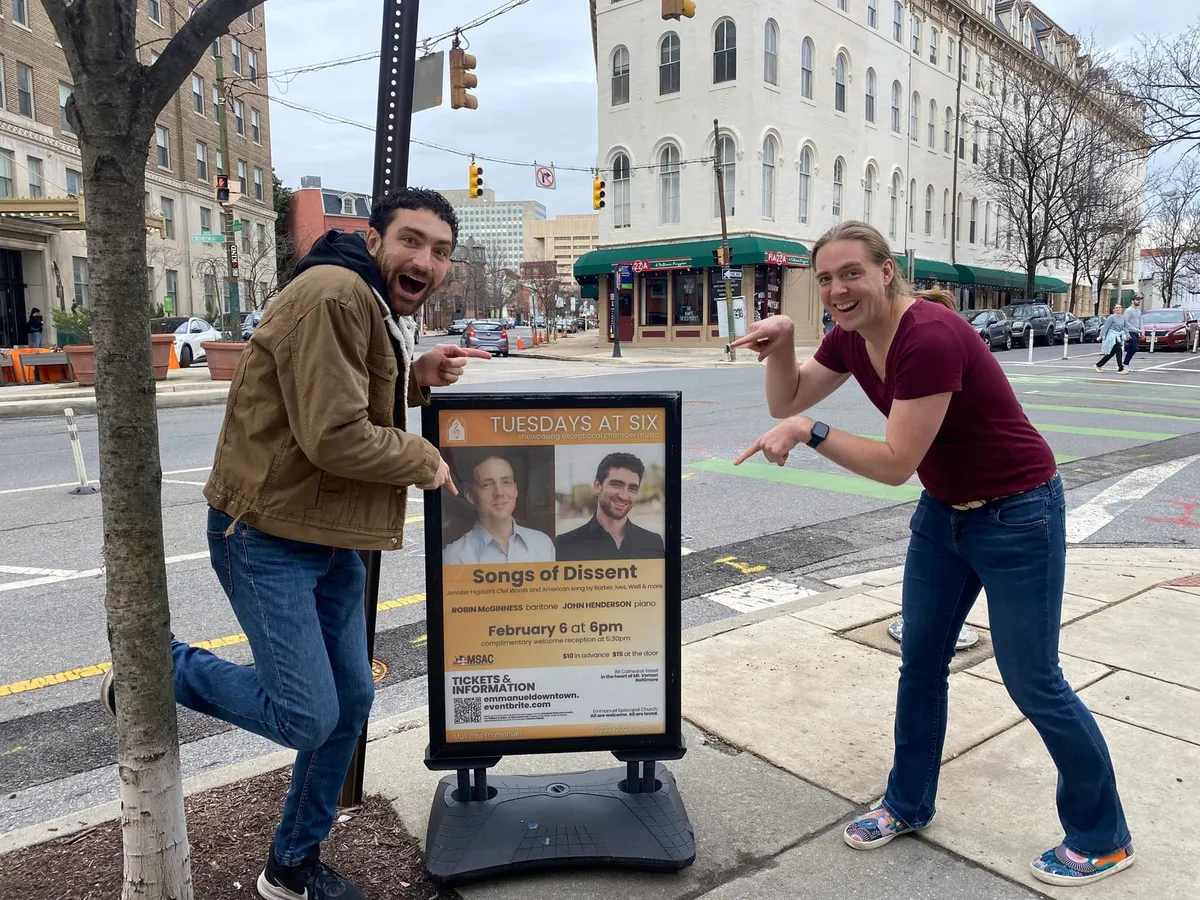
Program
Civil Words — Jennifer Higdon (b. 1962)
Enlisted Today · All Quiet · Lincoln's Final · The Death of Lincoln · Driving Home
Three songs of World War I — Charles Ives (1874–1954)
He Is There! · In Flanders Fields · General William Booth Enters Into Heaven
— brief pause —
A Modest Proposal (Jonathan Swift) — Max Eidinoff (b. 2000)
Ask Me to Rest · Beggar's Song — Samuel Barber (1910–1981)
Schickelgruber (Howard Dietz) · How to Survive (from The Threepenny Opera, trans. Marc Blitzstein) — Kurt Weill (1900–1950)
My Dearest Ruth (Martin Ginsburg) — Stacy Garrop (b. 1969)
Program Notes
Introduction
I'm continually drawn to works that challenge, unsettle, and provoke reflection. My partner and I often find ourselves engrossed in art that pushes boundaries and questions norms. While we appreciate the occasional indulgence in reality TV for its entertainment value and escapism, we're particularly drawn to pieces that delve deeper, stirring discomfort and prompting a reexamination of our values and actions.
In this program, Songs of Dissent, I'm endeavoring to share this quest for unsettling art. It's not merely about creating disquiet for its own sake; rather, it's about engaging with music that possesses the power to provoke thought and spark dialogue. I aspire for this program to offer not only moments of entertainment but also reflection, weaving together an experience that challenges, enlightens, and ultimately enriches.
Civil Words: Jennifer Higdon
We start with Jennifer Higdon's Civil Words, a title that is at odds with the disastrous violence of the American Civil War. What drew me to the work is its oblique yet poignant critique of war embedded within the music — the focus on civility during an uncivil time. This subtle approach to dissent provides an interesting contrast to the more direct expressions found in other pieces of the program.
In Civil Words, Higdon draws texts from a diverse array of sources. We hear from confederate and union voices, with a particular focus on President Lincoln, who is always a larger-than-life presence during explorations of this time period. Notably absent, however, are voices of enslaved and formerly enslaved people.
Musically, Civil Words is a landscape of sparse textures, demanding an exceptional vocal range for the baritone voice. Higdon's piano writing includes extended techniques that delve into the instrument's internal mechanics. These are relatively uncommon in art song repertoire. I see a deliberate violation, almost an act of battlefield surgery happening in front of our eyes.
Charles Ives: World War I Reflections
Charles Ives brings us into World War I, and we encounter songs that, at first glance, might seem more like propaganda pieces than anthems of protest. Ives, though a supporter of the war, grappled with the inherent contradictions of war and violence. His staunch belief in American ideals of democracy and liberty influenced his acceptance of the war as a necessary evil. I hear an undercurrent of discomfort in these first two songs, a sense of unease even as they promote the war's lofty goals to the fanfare of patriotic quotation.
Learning Ives' music is a test of musicianship. His compositions demand not only technical skill but also a willingness to embrace a certain wild abandon (just listen to his own take on the song "He Is There!"). Nowhere is this concept more vividly enacted than General William Booth Enters Into Heaven, an epic ode to the founder of the Salvation Army. The song was a cornerstone for me in programming this recital. I fell in love with this piece after hearing local baritone and Peabody professor William Sharp's interpretation.
The text's author, Vachel Lindsay, is the first of several vagabond poets who described themselves as beggars. General Booth… was Lindsay's breakout piece, and Ives was drawn to the evangelical exuberance that matched his own style (the poem's full text includes instructions for bass drum and banjos).
The song's portrayal of the "saved" and its portrayal of Booth are layered and complex. Ives lived next to Evangeline Booth, daughter of William, so he likely had a close awareness of the leadership of the Salvation Army. The song, to my ears, isn't just a straightforward hymn of praise; it's a nuanced critique. This is most apparent to me in the "round and round" section where Booth, so focused on himself and leading his army, walks right by Jesus.
A Modest Proposal: Max Eidinoff
A Modest Proposal is the second piece around which I formed the concept for this recital. What makes this piece especially compelling is its ability to bridge centuries. Swift's satirical essay, though penned nearly 300 years ago, holds an unsettling mirror to our present-day society.
Composer's note — Max Eidinoff: Jonathan Swift's 1729 satirical essay "A Modest Proposal For preventing the Children of Poor People From being a Burthen to Their Parents or Country, and For making them Beneficial to the Publick" is shockingly contemporary in its allusions to a widespread lack of empathy between people of different socioeconomic backgrounds. Swift is clearly responding to a popular sentiment by the rich that they are bothered by homeless people begging for money, as well as their tendency to generalize that all poor people are thieves. Along the way, he also touches on interconnected issues such as abortion and domestic violence. In the excerpts of text I have chosen, I have excluded any mention of Ireland or the 18th century in order to better highlight the similarities with present-day America. In this musical setting, the speaker is framed as a demagogue fully embodying all the hyperbolic and rapid mood shifts existing in the text, who radiates pride at having created the perfect solution to save their "great country."
Weill and Barber: American Art and Political Dissent
When I decided that this program would be all American song, I knew I wouldn't be able to resist programming Samuel Barber. I then proceeded to bend my rules by filling out the set with Kurt Weill. If Barber is my epitome of the American art song, Weill is my ideal of political art. However, while they shared time on earth, they approach music with very different styles. Juxtaposing them felt almost like an act of dissent itself.
The text likely sourced from a Quaker journal, "Ask Me to Rest" strikes me as the most honest and direct piece in this program. Composed at 16 years old, the piece was discovered posthumously. It's earnest and slightly naive — a glimpse into the early worldview of a great composer. "Beggar's Song" has more artifice to it, but is even more charming. The text is taken from the character of The Professor in True Travellers, A Tramp's Opera by W. H. Davies, another of our poets who self-identified as a beggar.
After becoming an American citizen in 1943, Weill composed several "Propaganda Songs." One such piece, "Schickelgruber," set to lyrics by Hollywood executive Howard Dietz, is a scathing mockery of Adolf Hitler. From its title, referencing Hitler's father's illegitimacy, to barbed critiques of Hitler's manhood and failed artistic career, Weill's composition combines a popular song style with disconcerting harmonic and rhythmic twists.
If pressed, I'd agree that Die Dreigroschenoper is not an American work (or is it truly British, being based on John Gay's Beggar's Opera?). Through Marc Blitzstein's translation, however, I think it finds its place in the program. "What Keeps a Man Alive" is an anthem against capitalistic overreach. In context, the piece is actually a duet for Macheath, the criminal antihero, and Mrs. Peachum, and closes out the second act. While not as widely known as "Mack the Knife" or "Pirate Jenny," this song has had popular adaptations, including a version by the Pet Shop Boys.
My Dearest Ruth
To close the program, I chose a piece written for an opera-lover known for her dissents, Justice Ruth Bader Ginsburg. The piece, set to a heartfelt letter written by her husband Marty, was commissioned by the family for Justice Ginsburg's 80th birthday.